Barcelona to Madrid without a car
- Train
Barcelona and Madrid are connected by one of Europe's busiest and most competitive high-speed rail corridors: a direct train that covers the distance in about two and a half hours, with three different companies fighting for your business. That competition has pushed fares down and frequency up, so there's rarely a reason to drive or fly between Spain's two largest cities.
Route facts
| By train | By car | |
|---|---|---|
| Distance | 621 km | 600 km |
| Journey time | ~2h 30m | ~6h |
| CO₂ per passenger | ≈ 22 kg | ≈ 102 kg |
| Typical fare | from €29 | — |
| Departures per day | ≈ 30 | — |
| Operators | Renfe AVE · Iryo · Ouigo España | |
Train or car?
The train wins easily: 2h30 city centre to city centre against roughly 6 hours of driving, plus three competing operators keep fares low enough that price stops being an excuse to take the car.
The train saves about 80 kg of CO₂ per passenger.
Distances and CO₂ are estimates, for comparison only.
The journey, leg by leg
- Barcelona Sants Madrid Puerta de Atocha
The journey, leg by leg
A single high-speed train leaves Barcelona Sants, crosses Catalonia and Aragón — with a brief stop in Zaragoza for most services — and arrives at Madrid Puerta de Atocha about two and a half hours later. There is no need to change trains or stations along the way.
Departures run nearly every hour throughout the day across all operators combined, making this one of the easiest long-distance trips in Europe to fit around a flexible schedule.
Three operators & when to book
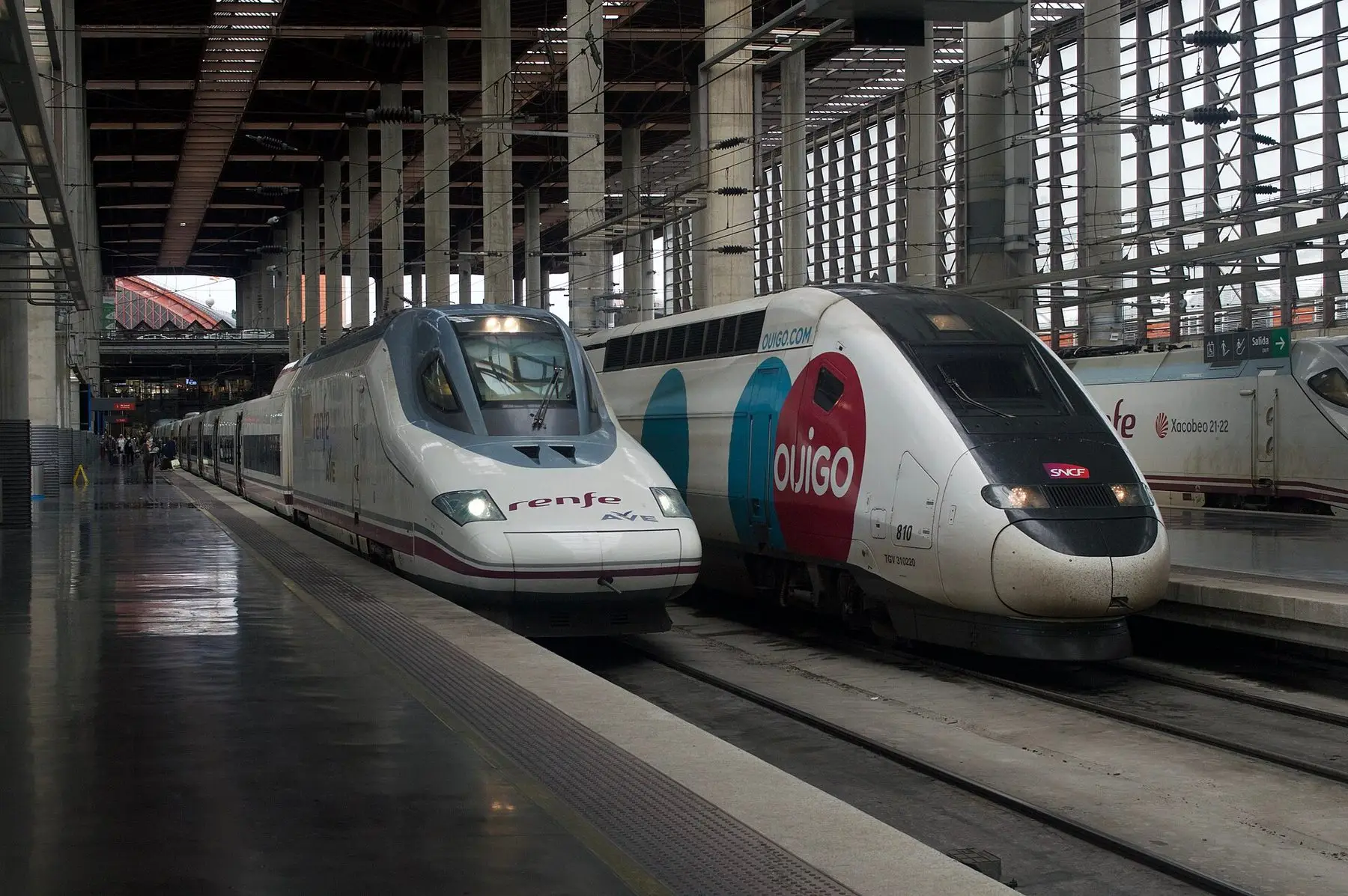
Since the line opened to competition, Renfe (the established operator, with the most schedule options and onboard comfort), Ouigo (a stripped-down, budget-focused service, usually the cheapest), and Iryo (a newer entrant with a more premium, business-class feel) have all run trains on this route. Comparing all three on their apps before booking is worth the extra few minutes.
Ouigo fares can start as low as 9–19€ if booked well ahead, though a realistic typical fare across operators is closer to 29–45€; Renfe and Iryo tend to sit a little higher but include more flexibility and comfort.
What to see along the way
The line crosses the wide plains of Aragón, with Zaragoza — home to the striking Basílica del Pilar — sitting almost exactly halfway and served by most trains. Breaking the journey here for a few hours is easy given how frequent onward departures are.
The scenery itself is mostly open countryside rather than a dramatic mountain crossing — the appeal here is speed, frequency and price, not the view from the window.
Doing it car-free at each end
Barcelona Sants connects directly to metro lines L3 and L5, putting Las Ramblas and the Gothic Quarter within a short ride. Madrid Atocha is just as central — its historic hall houses a lush indoor tropical garden — with metro line 1 and Cercanías trains reaching the rest of the city from the same building.
Neither city requires a car once you arrive: both have extensive metro networks that cover the centre and beyond, and Madrid and Barcelona are consistently ranked among Europe’s easiest big cities to navigate on foot and by public transport.
Before you use public Wi-Fi on the way
Wi-Fi on trains, ferries, in stations and in cafés is a network shared with other people. A VPN encrypts the connection between your device and the VPN server, one extra layer when you check email or log in to accounts on the move. NordVPN is one option.
See NordVPNFrequently asked questions
Is there a direct train from Barcelona to Madrid?
Yes. High-speed trains run direct between Barcelona Sants and Madrid Puerta de Atocha nearly every hour, taking about two and a half hours with no changes.
Which is cheaper: Renfe, Ouigo or Iryo?
Ouigo is generally the cheapest, with a no-frills service and fares that can dip below 20€ booked well ahead. Renfe offers the most schedule options and comfort, while Iryo sits in between with a more premium feel. Comparing all three before booking usually pays off.
How early should I book the Barcelona–Madrid train?
The cheapest fares, especially on Ouigo, appear when booking a month or more ahead. That said, with near-hourly departures across three operators, decent fares are usually still findable even a week or two out.
Can you visit Barcelona and Madrid without a car the whole way?
Yes, comfortably — both cities have extensive metro systems and the train stations sit right in the centre. No car is needed for the journey or for getting around once you arrive.
- from
- Barcelona
- To
- Madrid
- Duration
- ~2h 30m
- Typical fare
- €29
- Frequency
- Very frequent, near-hourly direct departures
- How you travel
- Train