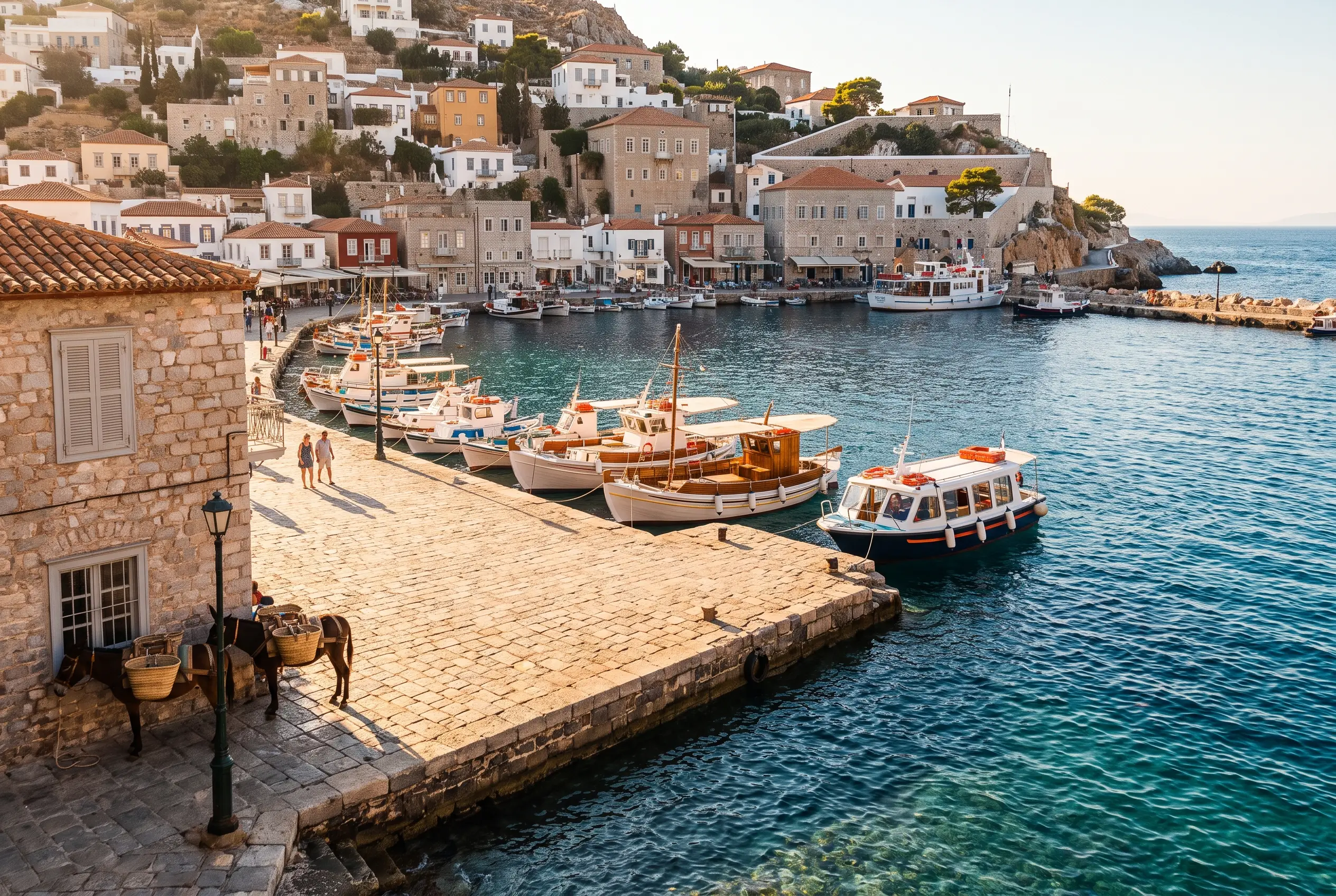
A surprising number of places around the world simply never let the car in — some by law, some because a bridge was never built, some because the whole point was to keep things as they were. This guide rounds up the best of them, from a Greek shipping-merchant harbour where mules still carry the luggage to a Great Lakes island that banned engines in 1898 and never looked back.
Why some islands ban cars altogether
The reasons vary, but they usually boil down to one of three things: geography (no room for roads on a cliff-hugging harbour town), history (the ban predates the car and was never lifted), or a deliberate choice to protect a fragile place from noise, exhaust and traffic. In every case, ferries do the heavy lifting — cars would need a costly car ferry, while people and luggage travel on ordinary passenger boats.
Getting around once you're there almost always means the same short list: walking, bicycles, small electric carts, and — on a handful of islands — horses. Emergency services, waste collection and deliveries are usually the only exception, running a few small utility vehicles that locals barely notice anymore.
The Aegean: Hydra and its quiet neighbours
Hydra has banned motor vehicles since well before cars existed to ban — the island's steep stone lanes were built for mules, and mules still carry the luggage from the harbour up to the guesthouses today. High-speed ferries reach Hydra from Piraeus, the port of Athens, in around 1h30 to 2h, making it an easy day trip or overnight stay.
Hydra is the best known, but it is not alone: a handful of smaller Dodecanese islands, such as Halki near Rhodes, keep only a token few vehicles for services and stay almost entirely car-free for everyone else. Ferry frequency to these smaller islands drops sharply outside the summer season, so it is worth checking timetables before building a tight itinerary around them.
Northern Europe: Sark and Giethoorn
Sark, one of the Channel Islands in the Bailiwick of Guernsey, has never allowed private cars at all — residents and visitors get around by bicycle, on foot, or by horse-drawn carriage, and the island's tractors are about as motorised as it gets. Ferries from Guernsey take roughly 45 minutes to an hour, depending on the operator and sea conditions.
Giethoorn, in the Netherlands, is not technically an island, but large parts of the village have no road access at all — houses sit along a network of canals, and getting between them traditionally meant a small flat-bottomed boat rather than a car. It earns its place on this list for having built an entire settlement around the same idea an island imposes by geography.
- Sark — reached by ferry from Guernsey; bicycles and horse-drawn carriages for hire on arrival.
- Giethoorn — reached by train to Steenwijk or Zwolle, then a local bus; punting boats and bicycles cover the village.
North America: Mackinac Island
Mackinac Island, on Lake Huron in Michigan, banned motor vehicles in 1898 after they kept spooking the horses — and simply never brought them back. More than a century later, bicycles and horse-drawn taxis and carriages remain the only way around, alongside a fudge-shop-lined Main Street built for exactly that pace of life.
Passenger ferries run from Mackinaw City and St. Ignace, on either side of the Straits of Mackinac, taking roughly 15 to 20 minutes — frequent in summer, much reduced or replaced by other means once the lake starts to freeze.
Italy: Venice and the Lido
Venice's historic islands have never had roads for cars at all — the city was built on water long before the automobile, and its bridges and alleys are sized for people, luggage carts and the occasional wheelbarrow. Everything moves by vaporetto, water taxi, gondola or on foot, and it works at a scale few other places can match.
The Lido, the barrier island just across the lagoon, is the exception worth knowing about: unlike the historic center, it allows a limited number of local and rental vehicles. Most visitors still find bicycles or the vaporetto the easiest way to explore its beaches and Liberty-style villas, treating any cars there as background rather than necessity.
Frequently asked questions
What's the most famous car-free island?
Venice's historic center is probably the best known car-free place on Earth, though it is technically a cluster of islands rather than one. For a single, classic island example, Mackinac Island in the United States and Hydra in Greece are the two most frequently cited.
How do you get around a car-free island?
Walking covers most of it, since these islands are typically small and compact by design. Bicycles are the next most common option, followed by horse-drawn carriages or taxis on a handful of islands, and small boats where canals substitute for streets, as in Giethoorn.
Are there any vehicles at all on these islands?
Usually a small number, reserved for essential services — fire trucks, ambulances, waste collection and deliveries typically get an exemption even where the general ban is strict. On Mackinac Island and Sark, these tend to be few enough that visitors barely notice them.
Is Giethoorn actually an island?
No — it's a village on the Dutch mainland, not surrounded by open water. It earns a place on this list because large parts of it have no road access at all, with houses linked by footbridges and canals rather than streets, producing the same car-free feel as a true island.
Should I book ferries in advance?
It is worth it in high season — routes to Hydra, Mackinac Island and Sark all see a surge in summer traffic, and the last sailing of the day can sell out. Outside peak months, walk-up tickets are usually fine, but always check that a reduced off-season schedule still gets you back before the last departure.