Hallstatt
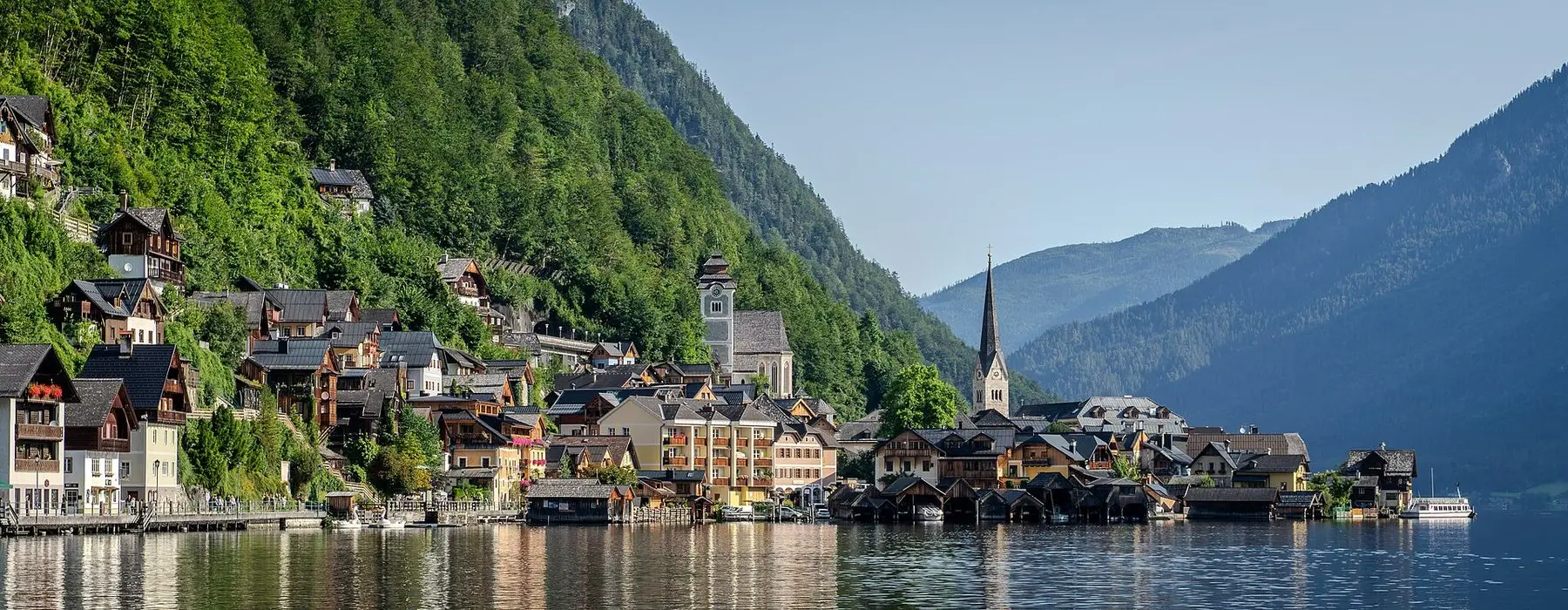
A lakeside village so small that its own train station sits on the opposite shore — you finish the trip by ferry.
- Train
- Ferry
- Bus
- Walk
No, cars are not really part of the picture in Hallstatt — the village is squeezed onto a narrow shelf of land between a mountain and a lake, and its own train station sits on the far shore, reachable only by boat. Regional trains from Salzburg and Vienna stop at Hallstatt Bahnhof across the water, a short passenger ferry carries you into the village itself, and once you're there the whole tiny centre is a ten-minute walk end to end.
Why it works without a car
- No through road reaches the village centre from the train side — the ferry across the Hallstättersee is how nearly every rail traveller arrives.
- The historic core is pedestrian by nature — lanes are too narrow for regular traffic, and visitor cars are kept out or heavily restricted.
- Regional trains connect straight through from Salzburg and Vienna via Attnang-Puchheim, no car needed for the whole approach.
- A funicular and marked trails reach the salt mine and skywalk above the village, no rental car required for the classic viewpoint.
How to arrive
Regional trains from Salzburg and Vienna change at Attnang-Puchheim onto the line along the Traunsee and Hallstättersee, stopping at Hallstatt Bahnhof — a small platform on the shore opposite the village, with essentially nothing else around it. A short lake ferry timed to meet incoming trains carries passengers across to the village landing stage in a few minutes.
Regional buses also run from Salzburg and from Bad Ischl into Hallstatt itself, crossing on the road that loops around the lake's far end — useful if the ferry is suspended for weather or off-season timetables run thin.
- From Salzburg — about 1h45 to 2h by train with the Attnang-Puchheim change, plus the ferry.
- From Vienna — roughly 3h30 to 4h by train via Attnang-Puchheim.
- Direct Postbus services run from Salzburg's train station straight into the village, no ferry needed.
- The lake ferry is seasonal and weather-dependent — it can be suspended in storms or on the coldest winter days, so check the current timetable before you travel.
Getting around
The village itself is tiny enough to see on foot in an hour, and everything worth reaching — the Marktplatz, the lakeside promenade, the Catholic and Protestant churches, the ossuary — sits within a few minutes' walk of the ferry landing.
Cars are largely kept out of the centre by design — narrow lanes, a controlled access system for residents and deliveries, and limited parking at the village edge that fills quickly in summer. Most day visitors never see a car at all once they step off the ferry.
Last-mile gaps
The famous skywalk viewpoint and the salt mine sit high on the mountainside above the village. A funicular (Salzbergbahn) runs from just behind the centre up to the mine entrance in a few minutes; from the top station, it is still a walk to the skywalk platform itself.
Hallstatt manages heavy day-tripper numbers with barriers and a booking system on the road into the village for tour coaches — travellers arriving by train and ferry generally skip that bottleneck entirely.
Travelling with luggage
The ferry crossing is short and flat, and the landing stage is close to most hotels, so bags are manageable for the core village. The catch is the transfer itself: gangways, a jetty and sometimes a queue, all easier without a huge suitcase.
If you're arriving by train, be ready to carry your own bags down to the ferry platform and back up on the far side — there are no porters at the Bahnhof, and taxis on the village side are limited and cannot enter the historic core.
Where to stay
Before you use public Wi-Fi on the way
Wi-Fi on trains, ferries, in stations and in cafés is a network shared with other people. A VPN encrypts the connection between your device and the VPN server, one extra layer when you check email or log in to accounts on the move. NordVPN is one option.
See NordVPNFrequently asked questions
Are cars allowed in Hallstatt?
No — not for visitors. The historic centre is largely closed to outside traffic, with narrow lanes, limited parking at the edge of the village and a booking system that controls tour-coach access. Residents, deliveries and emergency vehicles are the exceptions.
Why is Hallstatt car-free?
Mostly geography: the village is squeezed onto a narrow strip between a steep mountainside and the lake, so there was never room for wide streets. What little space exists is protected — Hallstatt is a UNESCO World Heritage site, and keeping traffic out preserves both the historic core and the daily life of the roughly 800 people who live there.
How do you get to Hallstatt without a car?
By train to Hallstatt Bahnhof, changing at Attnang-Puchheim from Salzburg or Vienna, followed by a short ferry across the lake into the village — or by direct Postbus from Salzburg, which drives right in without a boat.
Can you take luggage to Hallstatt easily?
It's manageable but not effortless. The ferry crossing itself is flat, but there are no porters at the lakeside train station, taxis are limited on the village side, and the historic core is off-limits to cars, so plan to carry your own bags the final stretch to your hotel.
How do you get around Hallstatt village?
Entirely on foot — the centre is small enough to cross in ten minutes, and every sight, from the Marktplatz to the ossuary, is a short walk from the ferry landing. The Salzbergbahn funicular handles the climb up to the salt mine and skywalk for anyone who doesn't want to hike it.
- Country
- Austria
- Region
- Salzkammergut
- How you travel
- Train
- Ferry
- Bus
- Walk
Keep exploring