Zermatt
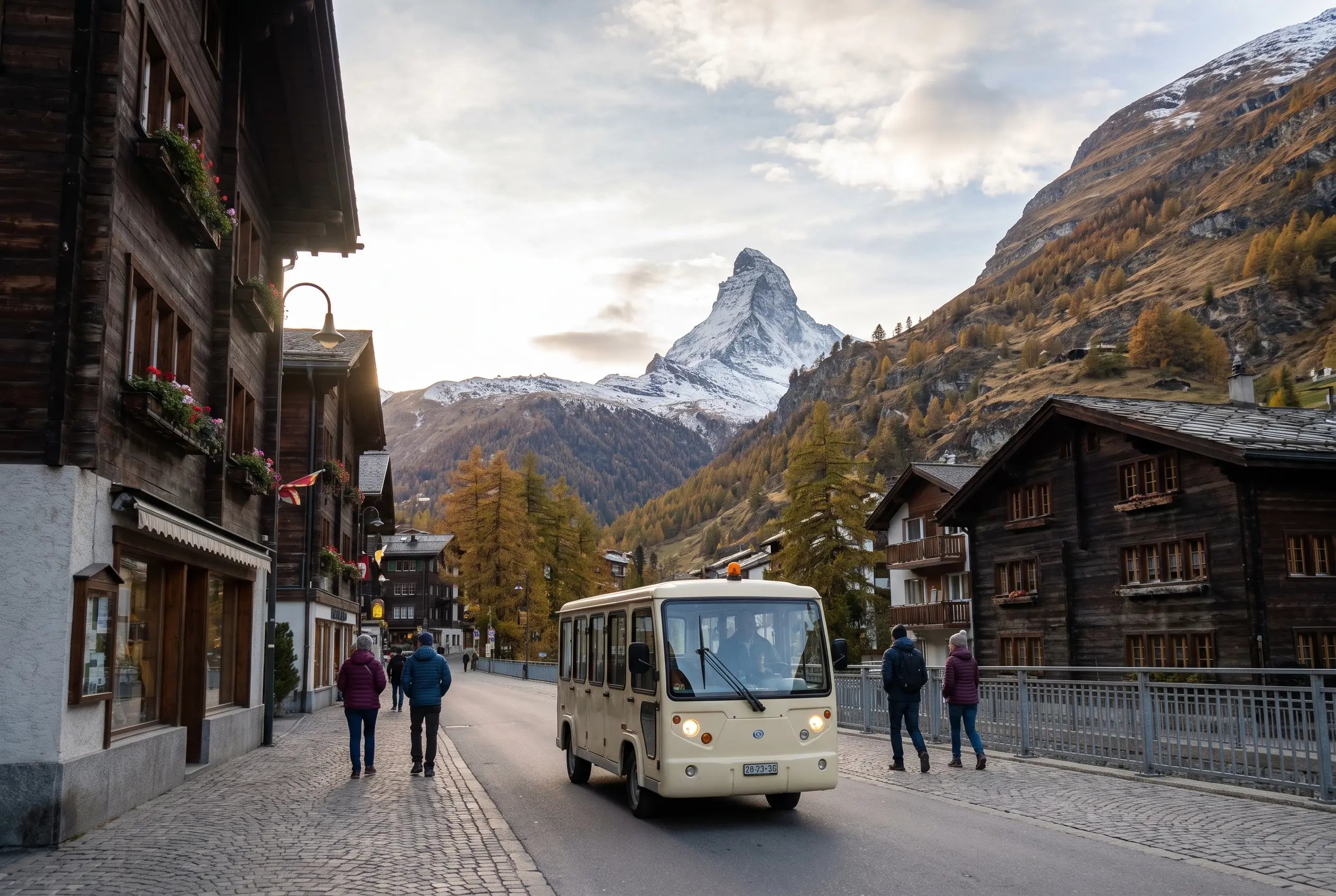
Car-free since 1961, with a cog railway in and only electric vehicles allowed inside — Zermatt is the closest thing the Alps have to a village built entirely without the combustion engine.
- Train
- Bus
- Walk
- Bike
Zermatt has been car-free since 1961, decades before "car-free" was a marketing term, and the whole village still runs on that decision. A cog railway brings you in from the valley, electric taxis and buses handle short hops, and an extensive network of mountain railways and cable cars reaches the trailheads and viewpoints — there is genuinely nowhere in Zermatt that a car would help.
Why it works without a car
- Combustion-engine cars have been banned from the village since 1961 — only small electric vehicles and taxis operate inside Zermatt.
- The Matterhorn Gotthard Bahn climbs from Visp or Täsch to Zermatt on a dedicated cog railway, the only practical way in.
- Drivers park at Täsch, the last village before Zermatt, and finish the trip on a frequent shuttle train that takes about 12 minutes.
- The Gornergrat Railway, open since 1898, and a web of cable cars reach the resort's highest viewpoints and trailheads directly from the village.
How to arrive
Visp, on the main SBB line between Bern/Lausanne and Brig, is the usual gateway — from there, the Matterhorn Gotthard Bahn climbs roughly 35 km up the valley to Zermatt in about an hour, with frequent departures throughout the day. Geneva and Zurich both connect to Visp with one change in Bern or via the Lötschberg line.
If you do drive to the region, the road ends at Täsch, a few kilometres before Zermatt, where a large park-and-ride garage connects to a dedicated shuttle train running several times an hour — cars simply are not allowed any further, so this handoff is built into everyone's trip, not an inconvenience unique to car-free travellers.
- From Geneva — about 3h30–4h via Visp, mostly by train.
- From Zurich — about 3.5 hours via Bern or the Lötschberg line to Visp.
- Visp to Zermatt — about 1 hour on the Matterhorn Gotthard Bahn, frequent departures.
- Täsch to Zermatt (for drivers) — about 12 minutes on the dedicated shuttle train.
Getting around
The village itself is small enough to cross on foot in about 20 minutes, and small electric taxis and buses cover the rest for anyone who prefers not to walk, especially with bags or in poor weather.
Beyond the village, an interconnected system of mountain railways and cable cars — the Gornergrat Railway, the Sunnegga funicular, the Rothorn and Matterhorn Glacier Paradise cable cars — carries hikers and skiers up to trailheads and slopes that would otherwise need hours of walking or a car that could never get there anyway.
Last-mile gaps
This is the rare destination with almost no last-mile problem — the entire point of the lift and rail network is to eliminate it. Nearly every trailhead, viewpoint and ski run has a station or lift stop at its base, built for exactly this purpose over more than a century.
The one thing to plan for is weather: cable cars and some higher trails close in poor conditions, so always check the day's operating status before setting out for a high-altitude viewpoint.
Travelling with luggage
Many hotels arrange to collect luggage from Zermatt station on an electric cart or taxi, so bags can travel separately from you on arrival — a small perk of a village built around not driving.
The station, main street and most hotel entrances are step-light and cart-friendly, so even a full suitcase is rarely a real problem here.
Tickets & passes
The Matterhorn Gotthard Bahn and connecting SBB trains are covered by a Swiss Travel Pass if you already have one for a wider trip; otherwise, point-to-point tickets are simple to buy online or at any station.
Mountain railways and cable cars (Gornergrat, Sunnegga, Matterhorn Glacier Paradise) are ticketed separately, with multi-day lift passes usually working out cheaper if you plan to ride several of them.
Where to stay
Before you use public Wi-Fi on the way
Wi-Fi on trains, ferries, in stations and in cafés is a network shared with other people. A VPN encrypts the connection between your device and the VPN server, one extra layer when you check email or log in to accounts on the move. NordVPN is one option.
See NordVPNFrequently asked questions
Is Zermatt really car-free?
Yes — combustion-engine cars have been banned from the village since 1961. Only small electric vehicles, taxis and buses operate inside Zermatt, and every visitor, whether they drove or not, finishes the journey by train or shuttle.
How do you get to Zermatt without a car?
Take a train to Visp, on the main line between Bern/Lausanne and Brig, then change to the Matterhorn Gotthard Bahn cog railway for the roughly hour-long climb into Zermatt. Departures run frequently throughout the day.
What happens if I drive to Zermatt?
The road simply ends at Täsch, a few kilometres before the village. Drivers park in a large garage there and finish the journey on a dedicated shuttle train that runs several times an hour and takes about 12 minutes — there is no way to drive any further.
Do you need a car once you are in Zermatt?
No — and you could not use one even if you wanted to. Combustion-engine cars are banned, the village is walkable in about 20 minutes end to end, and electric taxis, buses and an extensive mountain railway network handle everything else.
How do you reach the Matterhorn viewpoints without a car?
The Gornergrat Railway, running since 1898, climbs directly from the village to one of the best Matterhorn viewpoints in the region, and cable cars such as the Matterhorn Glacier Paradise and the Rothorn reach others — no road ever gets you as close as these lines do.
- Country
- Switzerland
- Region
- Valais
- How you travel
- Train
- Bus
- Walk
- Bike
Keep exploring