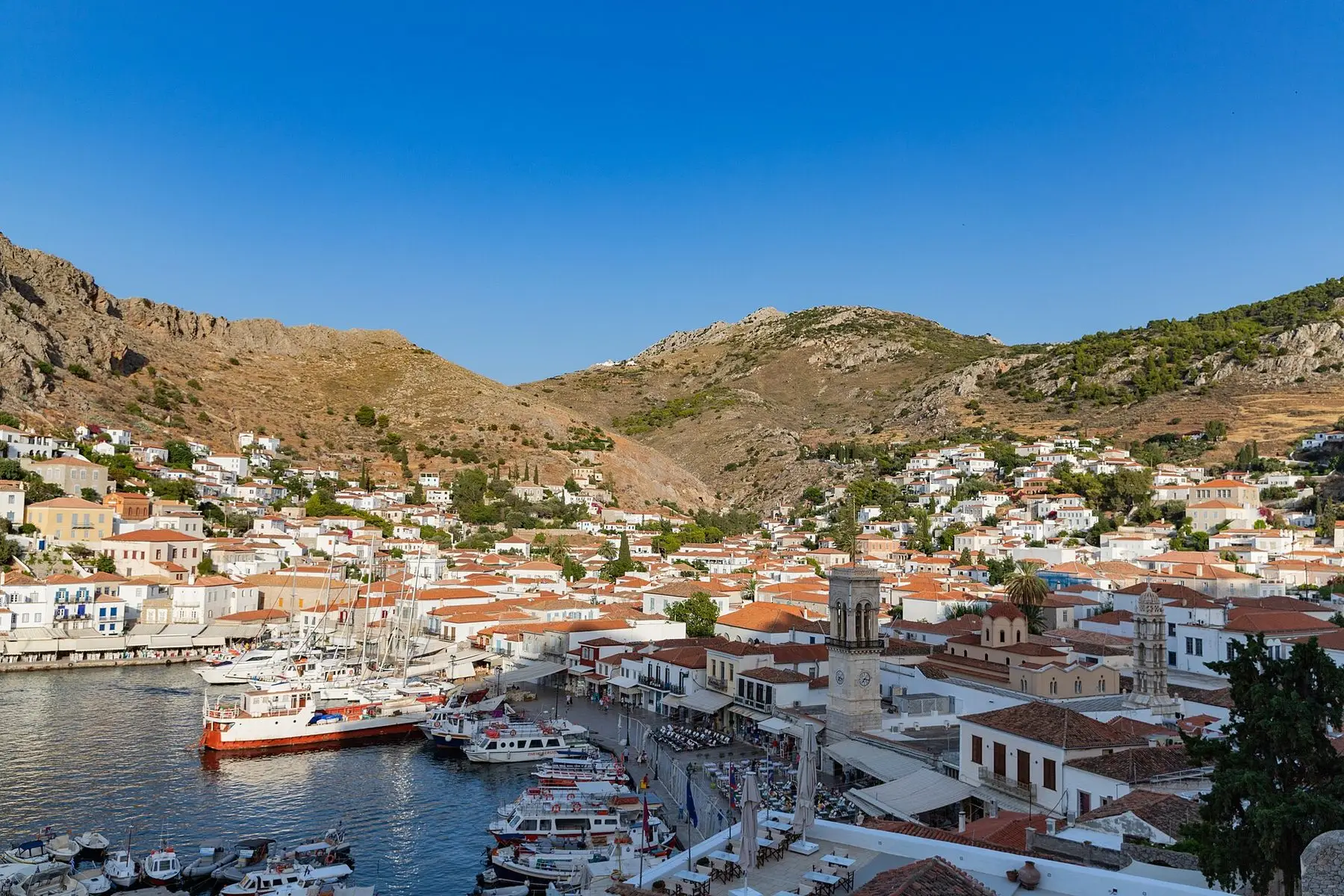
Hydra
No cars, no motorbikes, no exceptions — a Greek island where mules and water taxis have replaced every wheel since it was declared vehicle-free by law.
- Ferry
- Walk
No, cars are not allowed on Hydra — nor are motorbikes, scooters or any other motor vehicle, with only a handful of official exceptions like the rubbish truck and a couple of small municipal vehicles. It's one of the very few places in the world where the ban is total and has been for decades, so mules, hand carts and small wooden water taxis do the work that engines do everywhere else. High-speed ferries from Piraeus reach the island in under two hours, and from the harbour the whole car-free centre is a walk away.
Why it works without a car
- Cars, motorbikes and scooters are banned by law island-wide — Hydra is one of the only places on Earth with a total, permanent ban.
- Mules and donkeys still carry luggage, building materials and even furniture up the hillside lanes — the original local transport.
- High-speed ferries connect Hydra to Piraeus (Athens) several times a day, with no need for a rental car at either end.
- Small wooden water taxis shuttle between the harbour and the island's remoter beaches and coves, standing in for a coastal road that was never built.
How to arrive
Hydra has no airport and never will, so the ferry is the only way in. High-speed catamarans and hydrofoils leave from Piraeus, the port of Athens, several times a day year-round, with extra summer sailings.
Many ferries call first at nearby Poros or Spetses before or after Hydra, so double-check your boarding point and destination when booking. Piraeus itself connects to central Athens by metro, so the entire journey from an Athens hotel needs no car at all.
- From Piraeus — about 1h30 to 2h by high-speed ferry, direct or via Poros.
- From central Athens to Piraeus — about 30–40 minutes by metro Line 1.
- Sailings thin out considerably in winter and can be cancelled in strong winds (meltemi), so build a buffer day into island-hopping itineraries.
Getting around
Hydra Town, the port and only real settlement most visitors see, is compact and entirely walkable — the harbour promenade and the stone lanes climbing the amphitheatre of houses behind it cover almost everything you'll want to see.
For beaches and monasteries further out, water taxis leave from the harbour on demand or on a rough schedule, reaching spots like Vlychos, Kamini or the Zourvas monastery in 10–20 minutes. Mules are still hired for heavy loads and for reaching the hilltop monasteries on foot-only paths.
Last-mile gaps
Away from the harbour, lanes turn to steep stone stairs almost immediately — Hydra is a genuinely hilly island, and there is no vehicle of any kind to fall back on once the paving turns to steps.
Some hillside houses and small hotels are reached only by mule or a genuinely steep climb — ask your accommodation how far the last stretch is and whether a mule porter is available, especially in summer heat.
Travelling with luggage
This is a real pain point on Hydra: there are no cars or taxis to meet the ferry, and hotels away from the immediate harbourfront usually mean stone steps, steep lanes or both. A wheeled suitcase struggles fast once you leave the quay.
Porters with hand carts wait at the harbour and will carry bags to most hotels for a fee, and mules can be hired for heavier loads or steeper addresses — arrange this on the spot when you land, or ask your hotel to send someone down.
Tickets & booking
Ferry tickets are sold by several operators online, at Piraeus port and at kiosks near the departure gates. Booking a day or two ahead is wise in July and August, when boats can sell out; off-season, buying on the day is usually fine.
There is no port charge or day-tripper fee at present, but always double-check which pier your ferry departs from at Piraeus — the port is large and companies use different gates.
Where to stay
Before you use public Wi-Fi on the way
Wi-Fi on trains, ferries, in stations and in cafés is a network shared with other people. A VPN encrypts the connection between your device and the VPN server, one extra layer when you check email or log in to accounts on the move. NordVPN is one option.
See NordVPNFrequently asked questions
Are cars allowed on Hydra?
No — Hydra bans cars, motorbikes and scooters entirely, with only a rubbish truck and a couple of municipal vehicles as exceptions. It is one of the very few places anywhere with a complete, long-standing vehicle ban rather than just a restricted centre.
Why is Hydra car-free?
The island banned motor vehicles decades ago to protect its steep, narrow stone lanes and its status as a protected architectural heritage site, and the rule has held ever since. Hydra never built roads wide enough for cars in the first place, so the ban simply formalised how the island already worked.
How do you get to Hydra without a car?
By high-speed ferry from Piraeus, the port of Athens, in about 1h30 to 2h — there is no other option, since the island has no airport and no car ferry link. Piraeus itself is a short metro ride from central Athens.
How do you get around Hydra without a car?
On foot around the harbour and hillside lanes of Hydra Town, by hired mule for luggage or steeper climbs, and by small water taxi to reach beaches and villages further along the coast. These three have been the island's only transport for generations.
Can you take luggage to Hydra easily?
It takes some planning. There are no cars or taxis to meet the ferry, and many hotels sit up steep stone lanes, so pack light if you can. Harbour porters with hand carts and hired mules both cover the gap for a fee — arrange one as soon as you step off the boat.
- Country
- Greece
- Region
- Saronic Islands
- How you travel
- Ferry
- Walk
Keep exploring